


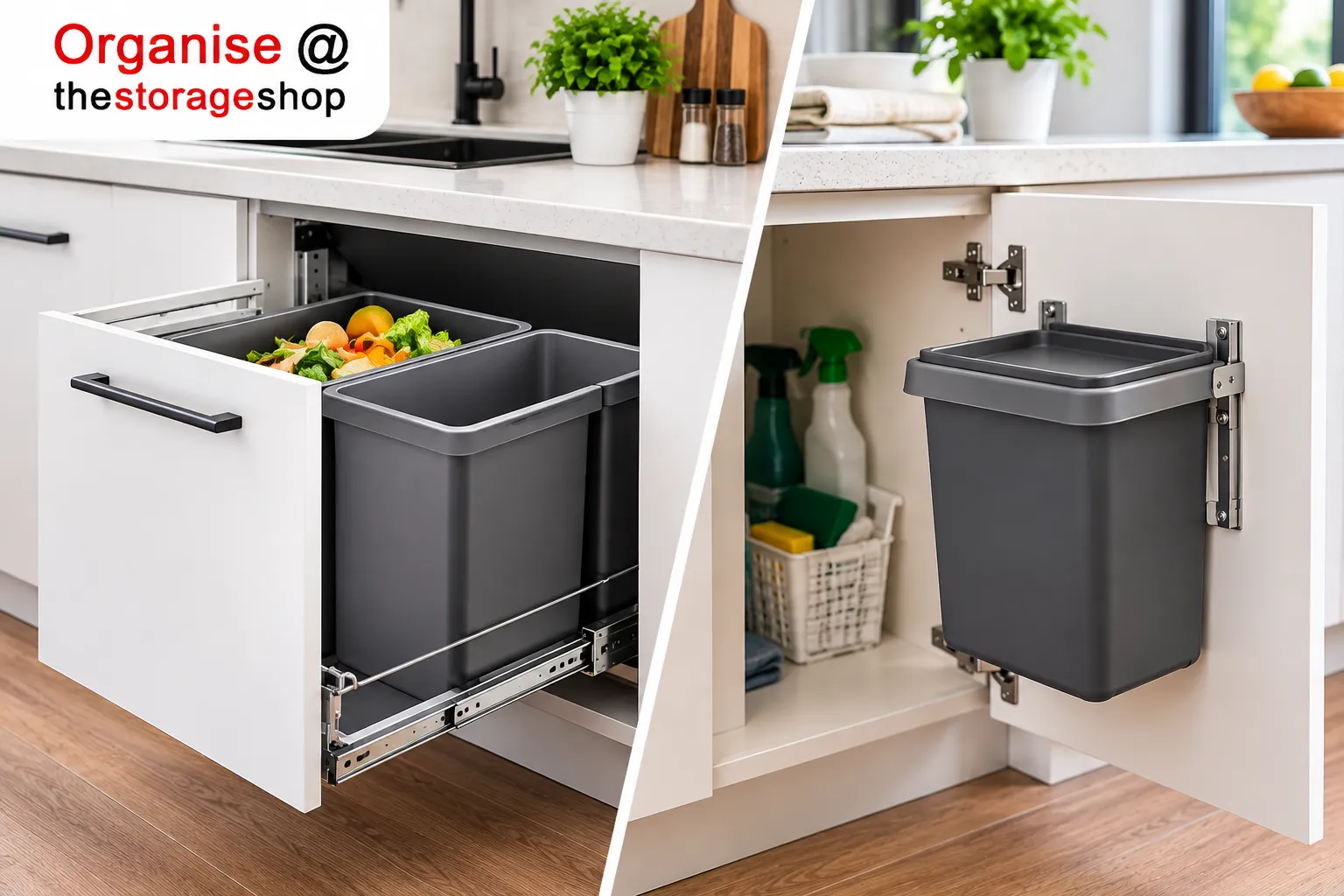
Quick answer: Most base cupboards 300mm or wider can hide a kitchen bin. Standard base cupboards are the easiest fit for pull out kitchen bins. Under-sink cupboards need a low bin that clears the pipes. A door mounted kitchen bin needs either a front that can become a drawer front, or a hinged door sturdy enough for a small swing-out bin.
Buying a bin before checking the cupboard is how plenty of people end up with a return label. The bin is the easy part. The cupboard decides what works.
Which cupboard suits which kitchen bin?
Each type of cupboard has a bin style that fits it best.
|
Cupboard |
Best bin style |
Check first |
|
Standard base cupboard, 400–600mm |
Double, triple or four-bucket pull out bin |
Internal width and runner clearance |
|
Narrow base cupboard, 300mm |
Slim pull out bin or small swing-out bin |
Width between the hinges |
|
Under-sink cupboard |
Low pull out bin or swing-out bin |
Height below the S-bend |
|
Base cupboard you can convert |
Door mounted pull out bin |
The door must become a drawer front |
|
Deep pan drawer |
Drawer-mounted bin insert |
Drawer brand and runner rating |
|
Corner cupboard |
Usually none; use the next cupboard |
Door opening width |
Standard base cupboards: the easy home for pull out kitchen bins
Most concealed bins end up in a standard base cupboard under the benchtop. It’s deep, square and solid, so the runners have a flat floor to screw into. A 400mm or 450mm cupboard takes most double pull out kitchen bins, enough for rubbish on one side and recycling on the other. At 600mm you can fit three or four buckets, which helps if your council collects food scraps.
Put it beside the sink or main prep bench, not across the room. You’ll open it many times a day.
Under-sink cupboards
The cupboard under the sink is the obvious spot, since scraps go straight from the chopping board into the bin. It’s also the trickiest, because the S-bend, waste pipe and tap hoses sit right where a tall bin would go.
Choose a low pull out bin that slides beneath the pipes, or a swing-out bin that moves with the door. Either way, keep the isolation valves reachable for a plumber.
What does a door mounted kitchen bin need?
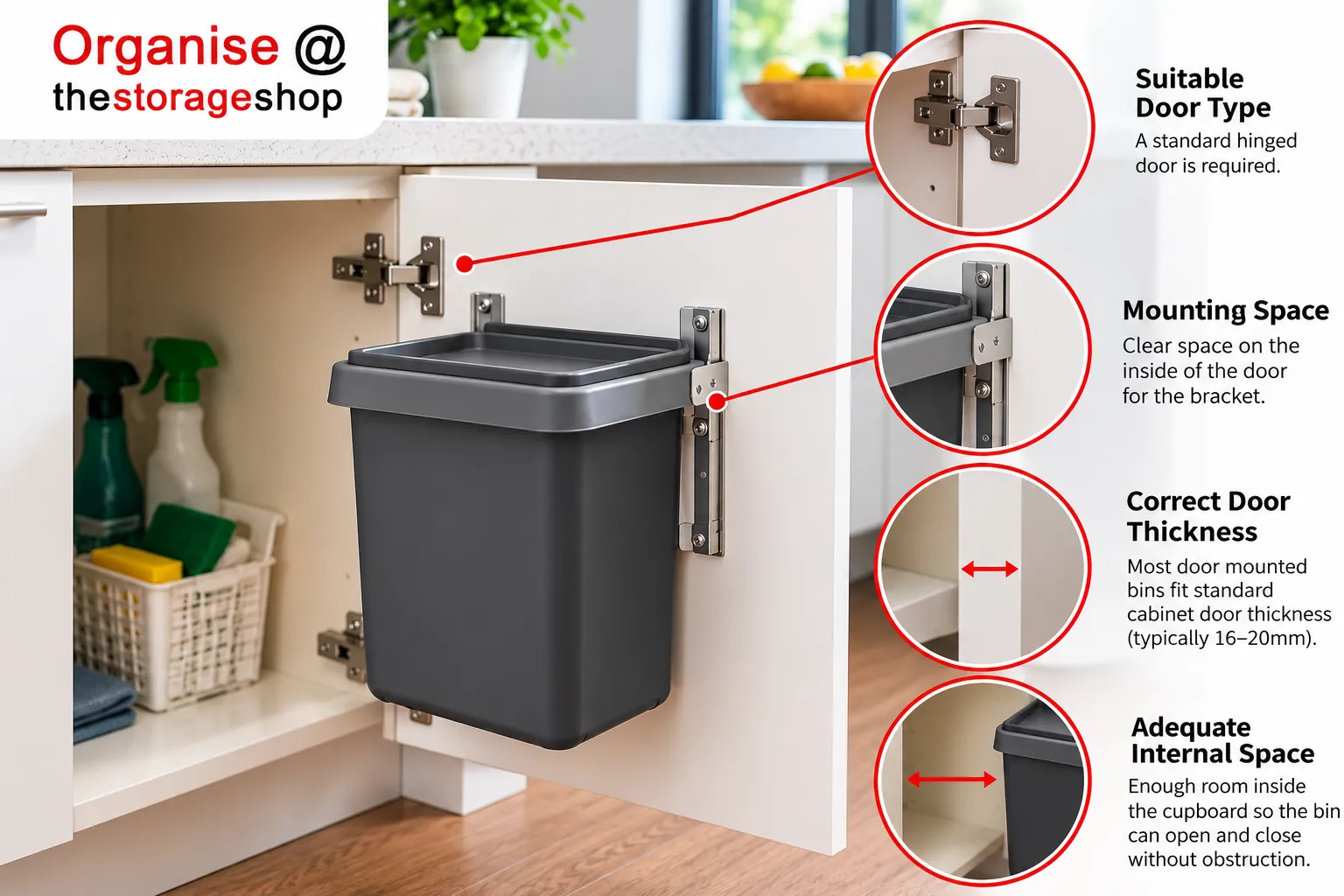
There are two kinds, and they ask different things of your cupboard.
A door mounted pull out bin replaces your hinged door. The front is fixed to a bin frame on full-extension runners, so the cupboard opens like a deep drawer. The runners carry the weight, not the hinges, which allows up to about 94 litres. This is the style most retailers sell as a door mounted kitchen bin.
A swing-out bin keeps your hinged door. A small bucket, usually 5 to 20 litres, moves out with the door. Some fix to the door itself and others to the cupboard side, so check where the weight sits and that the hinges are sound.
Drawers and corner cupboards
Got deep pan drawers instead of hinged cupboards? A drawer-mounted bin insert can sit inside one, as long as it matches your drawer system.
Corner cupboards are another story. Their awkward shape and narrow opening rarely suit a bin, so use the cupboard next door.
How to measure your cupboard
-
Width between the side panels. Most cupboards here are built from 16mm board, so a 400mm cupboard is roughly 368mm inside.
-
Depth to the rear panel or the nearest pipe.
-
Clear height under the benchtop or sink trap.
-
Door swing: open it fully and note anything it hits, like a dishwasher handle.
Compare those numbers with the bin’s minimum internal sizes, not the cupboard width it’s sold for.
Frequently asked questions
What is the best pull-out waste bin?
A double pull-out bin of about 35–45 litres with full-extension, soft-close runners is the best pull-out waste bin for most homes. It splits rubbish and recycling, fits a 400–450mm cupboard, and its buckets lift out for washing. Wesco, Hailo and Kia Ora are worth shortlisting.
What are the three types of garbage bins?
In Australia, the three main household bins are general waste with a red lid, recycling with a yellow lid, and organics with a green lid. These colours follow the Australian Standard for mobile waste bins. Some councils also run a separate glass bin. A double or triple pull out bin lets you sort the same streams in the kitchen.
What are door bins?
Door bins are kitchen bins that open with a cupboard door instead of being pulled out separately. Some are attached to the back of a drawer front and slide out on runners. Others are small bins that swing out with a hinged door, sometimes lifting the lid as they go.
What is the best rubbish bin for a kitchen?
The best rubbish bin for most kitchens is a concealed double pull out bin in a 400–450mm base cupboard. It hides the mess, frees up floor space and handles rubbish and recycling together. If you rent or can’t change your cupboards, a lidded pedal bin is the next best choice because it opens hands-free.
Can you fit a pull out bin in a 300mm cupboard?
Yes, a 300mm cupboard can fit a slim pull out bin. Expect about 16 to 34 litres, in one bucket or two smaller ones. Allow for the side panels too: a 300mm cupboard is usually only around 268mm inside.
Can I add a pull out bin to an existing cupboard?
Yes, most pull out bins are designed to retrofit into an existing base cupboard. Base-mounted models screw to the cupboard floor and work behind your current door, so many people fit them with a drill. Door mounted models take more work, because the hinged door is swapped for a drawer front.
Can you put a bin in a kitchen drawer?
Yes. A drawer-mounted bin insert sits inside a deep pan drawer, so the buckets come out whenever you open it. Inserts are made for specific drawer systems, such as Blum or Hettich, so match the brand and width before buying.
The bottom line
Start with the cupboard, not the catalogue. A standard base cupboard suits almost any pull out bin, an under-sink cupboard needs a low one, and a door mounted bin suits a cupboard you’re happy to convert. Measure inside, then match those numbers against the range of kitchen bins in cupboards at The Storage Shop.